
For a meditation after work, sit down before you start the evening's chores, put your phone out of reach and spend seven minutes following your breath. The practice marks the end of the workday so that the job stops following you into the evening.
Research on recovery from work uses the term psychological detachment: mentally stepping away from the job outside working hours. A 2020 pair of experiments in Frontiers in Psychology found that detaching from work reduced negative mood, and that the effect was strongest when compared with thinking negatively about work. Meditation is one way to practise that step away.
A seven-minute after-work sitting
- Change something small first. Take off your work shoes or badge, wash your hands, or step outside for a moment. Then choose a seat that is not your desk.
- Set a timer for seven minutes. Silence your phone and place it out of reach.
- Sit on a chair with your back supported and both feet flat on the floor, about hip-width apart, as the NHS breathing exercise for stress describes. Rest your arms on your lap or the chair arms.
- For the first minute, breathe in through your nose and out through your mouth, counting from 1 to 5 on each breath if that helps. The NHS notes that you may not reach 5 at first, so let the count follow the breath and do not force it.
- Let the counting go. For the next five minutes, keep your attention on the breath where you feel it most, at the nostrils or the belly. The National Center for Complementary and Integrative Health describes one type of meditation as maintaining mental focus on a particular sensation, such as breathing.
- For the last minute, notice the sounds in the room and the weight of your body on the seat. When the timer sounds, open your eyes and decide what the first thing of the evening will be.
When the workday keeps replaying
Expect the inbox, the meeting and tomorrow's list to turn up. The NHS guide to mindfulness describes thoughts as mental events that come and go, and says that in meditation you keep bringing your attention back whenever the mind starts to wander. Silently say "work" to the thought, then return to the breath. Each return counts as practice. The guide to a wandering mind has more on this.
If one task will not leave you alone, write it on a note before you sit and tell yourself it is waiting on the page. The Frontiers experiments found that positive thinking about work also improved mood, and more so than detaching in those comparisons. Nothing says every work thought has to be pushed away, only that the sitting is not the time to solve it.
Where it fits in the evening
Do it before dinner, before the television goes on or before you open another screen, so the break has a clear start and end. If the evening is already late, the meditation before bed guide covers the wind-down.
Seven minutes is a starting length. The guide to how long to meditate covers lengthening it. At lunchtime, the midday meditation guide has a five-minute version.
When to skip it
The NHS says that many people find mindfulness helpful, but it is not right for everyone, and that for some it can make them feel worse. The NCCIH says these practices usually are considered to have few risks, although few studies have looked for harmful effects, and advises against using them to replace conventional care. If sitting still after work leaves you more unsettled, stop and do something active instead.
Next step
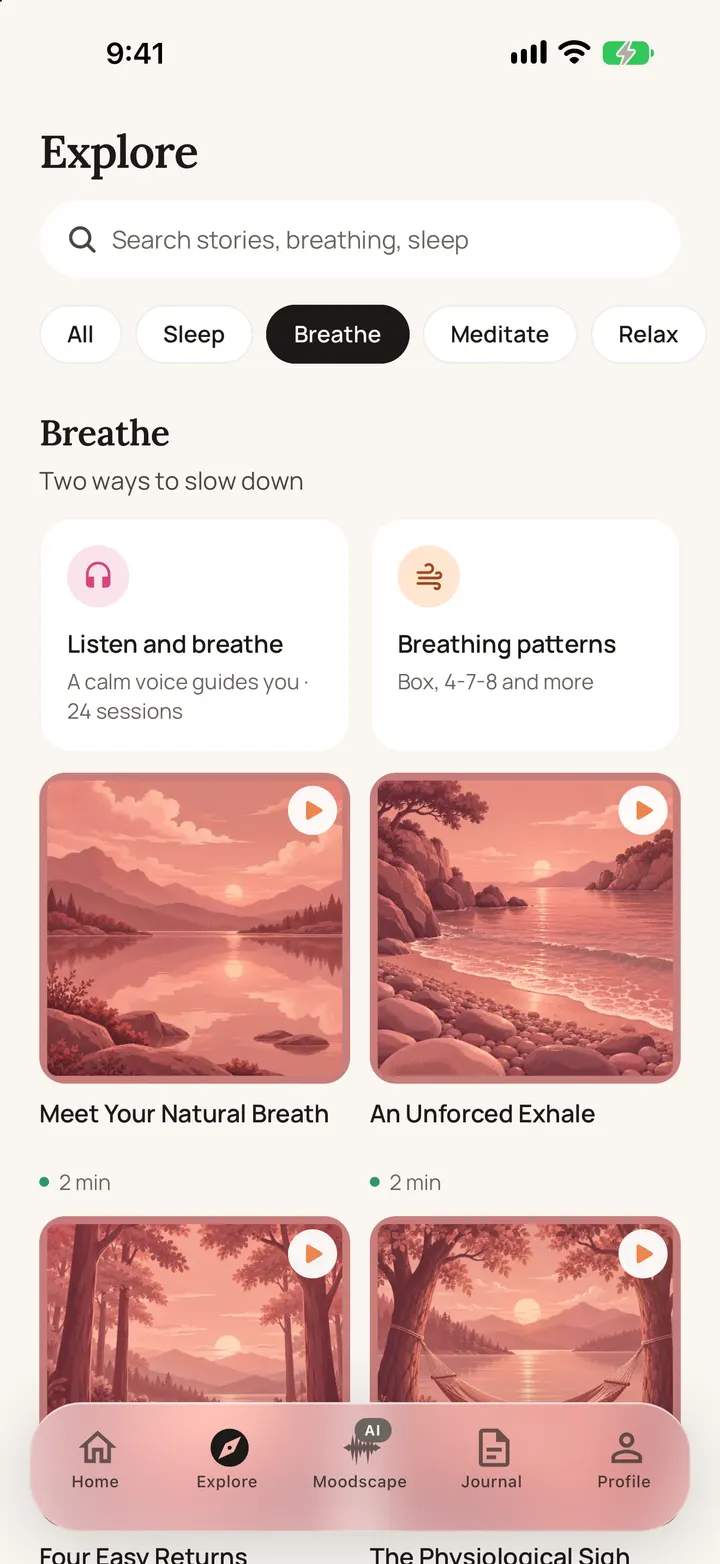
In Moodscape, Midday on Home runs from 11:00 to 19:00 local time: a short breath, a sigh or box breathing, then one short guided session that plays once. From 19:00, Tonight takes over with a 2-minute 4-7-8 breath, then a sleep story that plays once and stops on its own. Explore guided meditations on the web or get Moodscape for iPhone.