

A morning meditation routine can be as small as ten minutes: wake at a steady time, sit down before you open your phone, breathe slowly for a couple of minutes, then spend the rest following a guided session or resting attention on your breath. A fixed cue and a fixed place make it easier to repeat.
Why the morning suits a routine
Habit research points to a cue. In a University College London study summarized by the British Psychological Society, participants repeated a new behaviour once a day, linked to a daily cue, for 84 days. The average time for the behaviour to stop becoming more automatic was 66 days, though it varied from 18 to a predicted 254 days, and about half of the participants had not reached a habit-level score by day 84. The same summary says a single missed day had little impact, with some evidence that too many missed repeats had a cumulative effect.
The morning gives you a ready-made cue, because you wake up every day. The NHS suggests picking a regular time for mindfulness, such as the trip to work. The NHS also says going to bed and getting up at similar times each day helps your body know when it is time to sleep, so a fixed wake-up time supports the routine from both sides.
A 10-minute morning routine
- Get up, drink some water and use the bathroom. Leave your phone alone until the session is over.
- Choose a chair or the edge of the bed with your feet on the floor and your back upright but not stiff. Use the same spot each day.
- Breathe slowly for 2 minutes. Breathe in through the nose for four counts and out for six, and let the rhythm settle.
- Practice for 6 to 7 minutes. Either follow a guided meditation, or rest your attention on the breath at the nostrils or belly. The NHS describes mindfulness meditation as paying attention to thoughts, sounds and the sensations of breathing, and bringing your attention back when your mind wanders.
- Take one more slow breath, open your eyes and notice the room before you stand.
If your mind wanders, that is the practice. The guide to what to do when your mind wanders covers the return in more detail.
Make it stick
- Do it straight after the first drink of the day, or right after brushing your teeth.
- Ten minutes you repeat beats thirty you skip. If mornings are rushed, the short guided meditations guide shows how to fit in five.
- After a missed day, sit the next morning at the same time and the same length.
- On busy mornings, a counted pattern can help. The box breathing guide explains one.
If you are restarting after time away, see how to restart a meditation habit after a break.
When to adjust
Meditation usually carries few risks, though the National Center for Complementary and Integrative Health notes that few studies have looked at harmful effects. A 2020 review it cites found about 8 percent of participants had a negative effect, most often anxiety or depression. If a morning session leaves you uneasy, stop and do something lighter, and consider speaking with a health professional. This guide is general information, not individual advice.
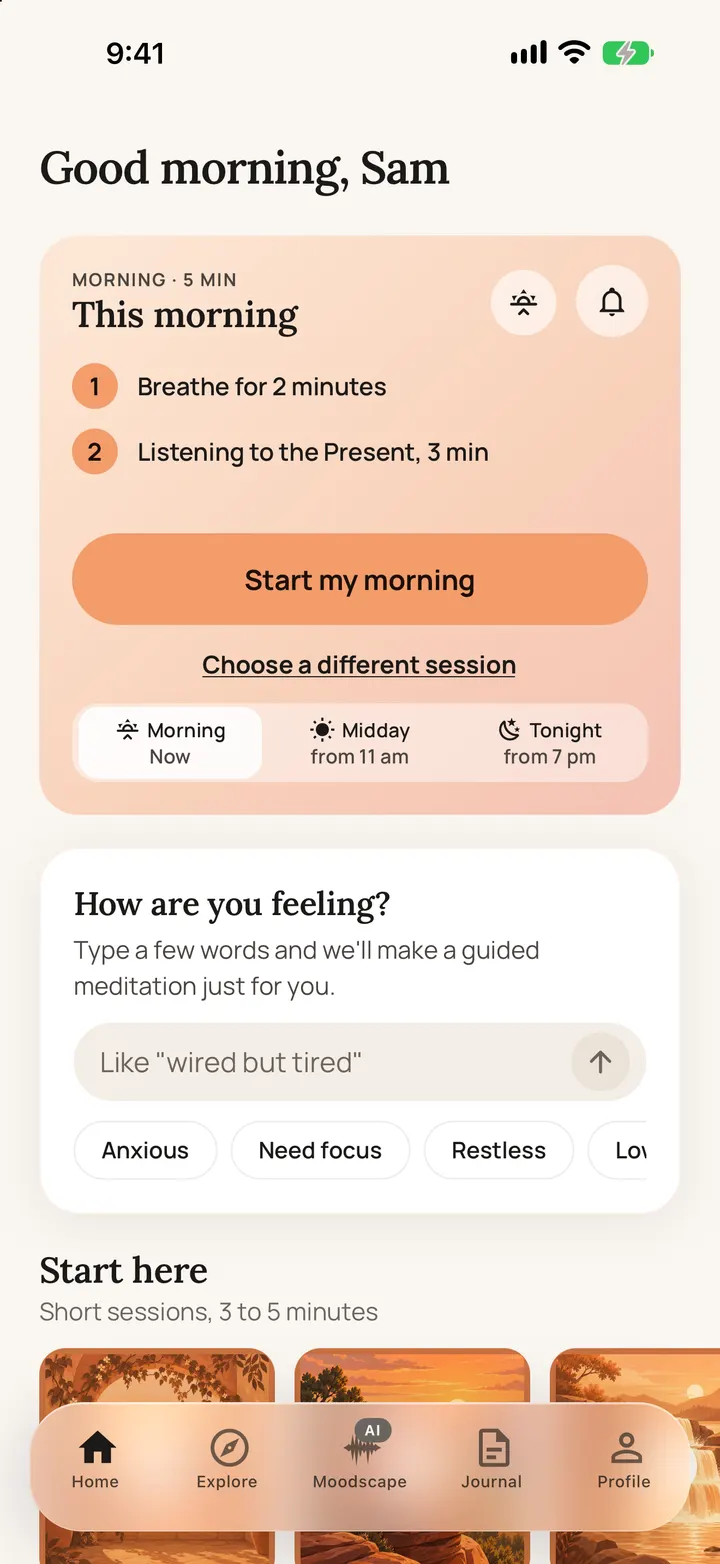
Try it tomorrow morning
Moodscape's Meditate section is a guided meditation catalog. Explore guided meditation on the web or get Moodscape for iPhone. Some sessions are free and others require Premium.