

The best time of day to meditate is the one you will repeat. For a starting point, try the morning: it is the only time of day with any research behind it, and that research is limited. The NHS gives practical advice that points the same way: pick a regular time, such as the commute to work or a walk at lunchtime.
What the research found
A 2023 observational study, "Time of Day Preferences and Daily Temporal Consistency for Predicting the Sustained Use of a Commercial Meditation App", followed the first 180 days of 14,879 accounts on one meditation app. The chance of meditating on any given day dropped for everyone over that time. The drop was smallest for morning sessions: 63.4 percent, against 67.8 to 74.5 percent for other times of day.
People who did a larger share of their sessions in the morning also kept going longer. People who did a larger share late at night kept going for a shorter time. Midday sessions showed no significant link to either outcome, and evening sessions showed none with long-term use.
This is an observational study of one app's users. It shows that morning meditators tended to stick with it, not that the morning causes sticking with it. People who have a calm early hour may simply have an easier time with any routine. The authors suggest that morning routines and daily body rhythms may make the morning a good time to build a new habit, which is a hypothesis, not a result.
The study also found that people whose sessions landed at more varied times kept using the app longer. So moving a session to another time on a hard day is not a reason to give up the habit.
How to choose your time
- Start with the slot that already has a cue. Right after waking, right after brushing teeth, or on arrival at work all give the session something to follow. Pick one and attach the session to it.
- Check the slot against your week. A time that works on Monday but collides with the school run on Wednesday will not hold. Choose a window that survives a normal week.
- Try it for seven days, then adjust. If you keep missing the slot, change the slot, not your resolve.
- Have a backup time. Decide now where the session goes when the first choice falls through, such as a lunch break or the commute home.
Morning
Waking up gives you a built-in cue, so the session can follow something you already do every day. If you choose the morning, the morning meditation routine lays out ten minutes step by step.
Midday
A midday session is a reasonable choice if your mornings are crowded. The research above found no significant link between midday sessions and sticking with practice, which does not mean they are worse. It means this study could not tell. A few minutes at your desk is a workable version, and the guide to meditation for focus at work shows one.
Evening and bedtime
If the evening is when you have time, that is a good reason to choose it. The late-night finding above is an average across many users, not a rule about you. If you meditate before sleep, the NHS advises that going to bed and getting up at similar times each day helps your body know when it is time to sleep, and describes a calm bedtime routine as a way to prepare for sleep. The meditation before bed guide has a ten-minute wind-down.
How long to sit
The time of day matters less than showing up. Five minutes at a time you keep beats thirty minutes at a time you skip. The guide on how long you should meditate goes through lengths, and the short guided meditations guide covers fitting a practice into a full day.
Try it this week
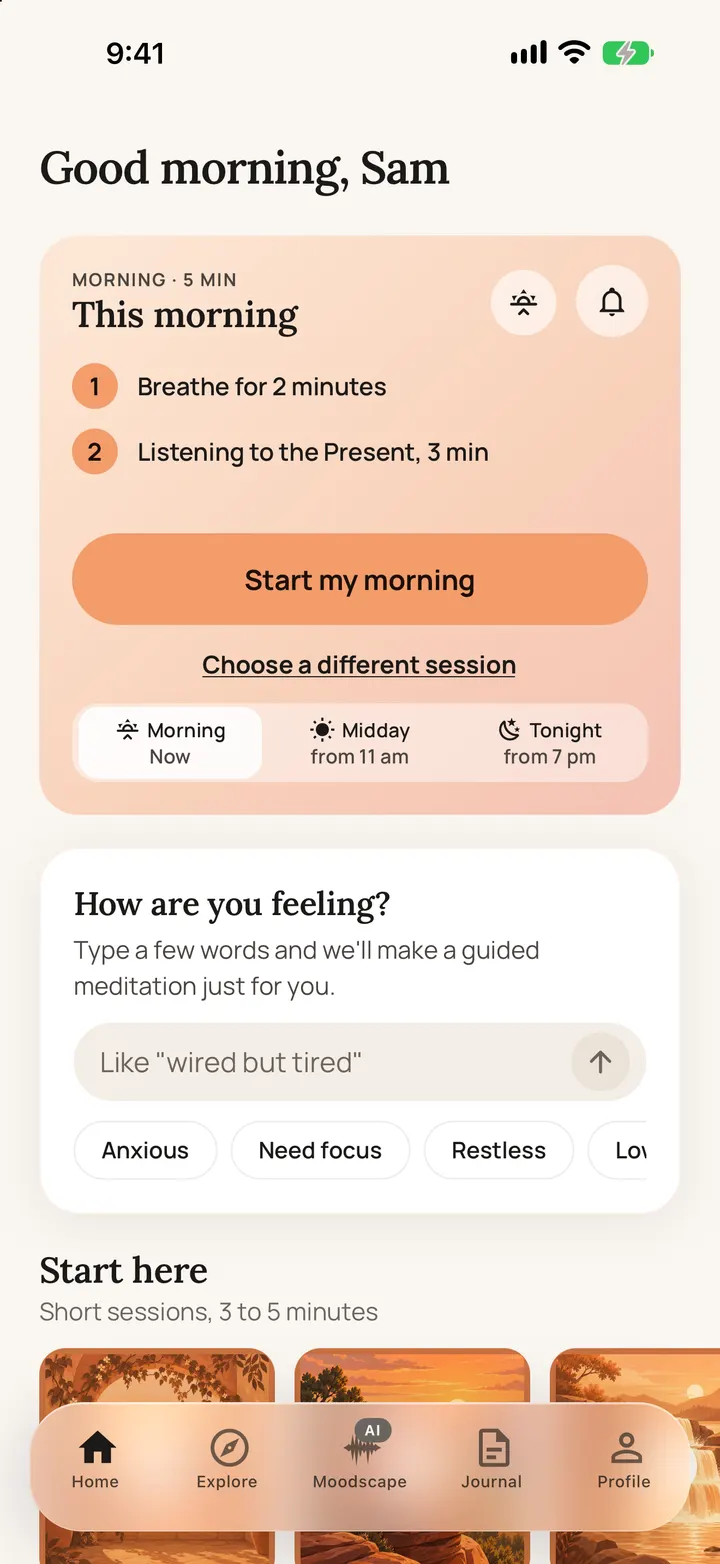
Moodscape's Meditate section is a guided meditation catalog. Explore guided meditation on the web or get Moodscape for iPhone. Some sessions are free and others require Premium.